
Introduction
We’re big fans of Jurgen Appelo’s 7 Levels of Delegation model. It makes delegation more useful by expanding your options beyond “Mine, Yours, and Ours.” It helps avoid “delegation theater,” where you say “you own that decision,” they do something you don’t like, and then you say, “never mind, I own that decision now.” It aligns nicely with a classic HBR article, “Management Time: Who’s Got the Monkey,” and its advice about initiative levels.
We didn’t invent the model, but we’ve used it enough to work through some important questions we haven’t seen answered elsewhere. Questions like: “When should a leader be at a Level 1 (Tell) instead of a Level 3 (Consult)?” Or, “If someone delegates something to me at a Level 5 (Advise), how do I use that level well?” Or, “Level 4 (Agree) sounds like a slow, politically riddled nightmare. Should we ever intentionally be at a 4?”
So, with gratitude to Jurgen for developing the model, we share our advice on when to use each level and how to use it well. We’ll write this as if you, the reader, are the person doing the delegating, so that you know when and how to use each level. At levels 5–7, we’ll add some advice for those being delegated to for how to use the delegation well. Read it from top to bottom for a good overview of the model, or jump to the level you’re considering using. It works either way.
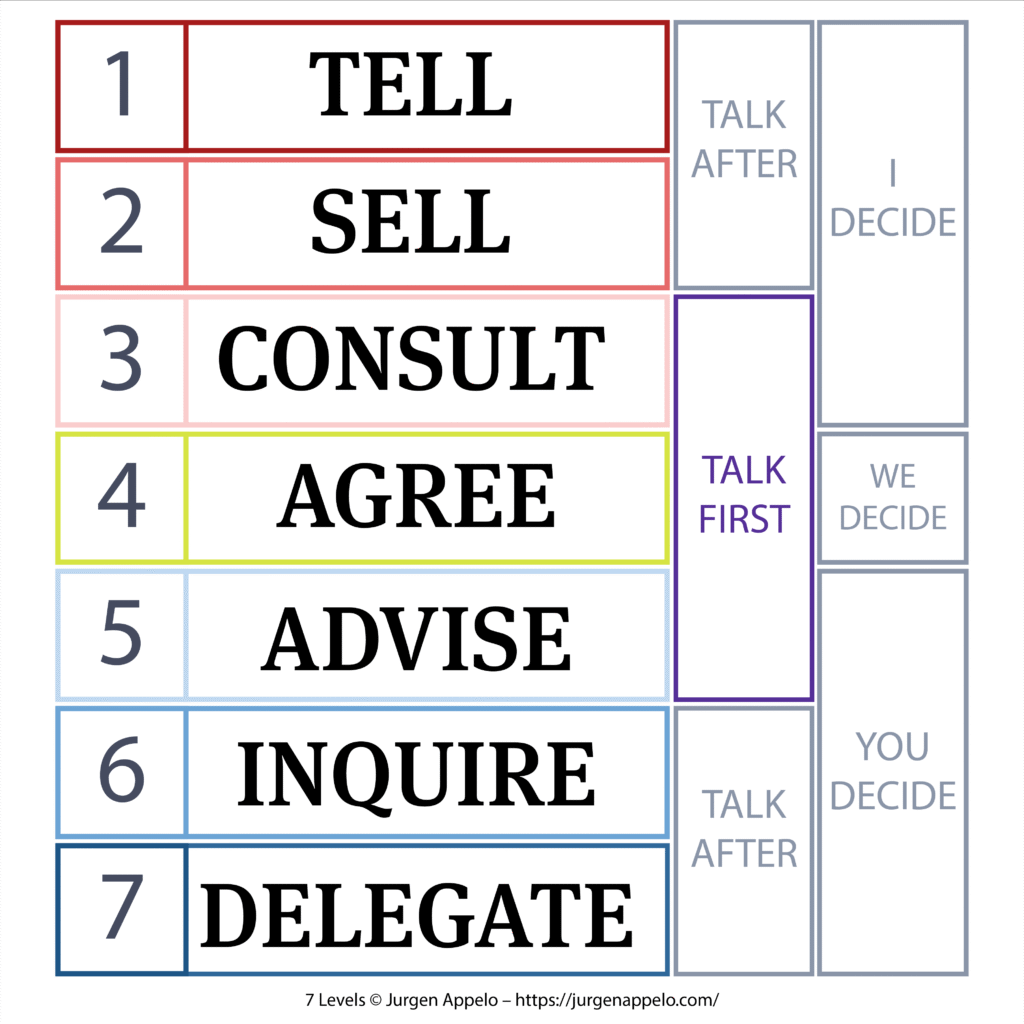
1 – Tell
Summary of Level 1 Decisions
“Here’s the final decision. Let’s make it happen.”
At Level 1, you’re making a decision and communicating it. The communication is not about persuading people that the decision should happen. Instead, you are providing enough context and detail so people can implement it well. You announce the decision after you’ve already made it, and no one expects to change your mind. The only questions about the decision should concern how to make it happen.
When to Use Level 1 Decisions
Level 1 decisions are the right call when at least one of these is true: extreme urgency, hard to reverse stakes, or responsibility can’t (or shouldn’t) be shared.
Any other situation warrants at least a Level 2 (Sell) or Level 3 (Consult).
How to Use Level 1 Well
Many leaders avoid Level 1 because they fear backlash or don’t want to be seen as too dictatorial. Others overuse it because they confuse autocratic authority with “strong leadership.” Effective leaders use Level 1 when it’s the best way to create a good outcome in both the short and long term. While they may listen privately before making the decision, they decide alone, communicate with clarity, and hold themselves personally accountable for the consequences.
To use Level 1 well, announce the decision with clarity, confidence, and accountability. Say explicitly that you are at a Level 1 and what that means. For example: “I’m at a Level 1 on this decision. The decision is made. What’s open for discussion is how we implement it.” Even at Level 1, communication still matters. The difference is what is open for discussion. Your goal is to make the implementation as smooth as possible.
One useful approach is to move through Eli Goldratt’s “Five Layers of Resistance,” providing just enough context to support execution while keeping the focus on implementation:
- The problem you’re addressing and why it must be addressed now at Level 1, rather than using a Level 2 or 3 approach
- Your decision, or solution
- The side effects of your decision and any plans to mitigate them
- Obstacles you anticipate in implementation, such as time or resources, and how you plan to address them
- The collaboration you’ll need from specific people, roles, or departments to make the decision successful
Example Level 1 Decision
There are far more ineffective Tell decisions than good examples, but history does provide a few strong ones. In July 1862, U.S. President Abraham Lincoln informed his Cabinet that he had already decided to issue the Emancipation Proclamation and was not seeking approval or debate. He invited input only on timing and wording. When some Cabinet members raised political objections, he listened without reopening the decision itself, incorporating advice about when and how to announce it, but not whether to proceed.
Acting under his authority as commander in chief, Lincoln delayed the public announcement until after a Union military victory so it would project resolve rather than weakness, then issued the proclamation unilaterally. He framed it as a necessary war measure, clearly stated its scope and limits, and took full responsibility for the consequences rather than sharing or deflecting the burden of the decision. He famously told a confidant that the proclamation might very well cost him the election.
2 – Sell
Summary of Level 2 Decisions
“Here’s the final decision. What questions can I answer about it before we make it happen?”
At Level 2, you are making a decision and then explaining it and your reasoning. Your goal is to convince others it is a good one. Like Level 1, you communicate the decision after you’ve already made it. People can ask you to explain your thinking and justify your decision, but they shouldn’t expect the discussion to change it. Instead, the goal is to better understand why the decision was made.
When to Use Level 2 Decisions
A good Level 1 decision feels like “no more questions, let’s execute.” A good Level 2 decision feels more like “I’ve decided, but I want you to understand why; what I considered, how I arrived at the decision.” Some of the characteristics of Level 1 decisions apply here, such as urgency and high stakes. The difference is that at Level 2, you are willing to take the time to explain and persuade. Level 2 decisions can still be made quickly, creating clarity while inviting inquiry into the decision’s context and your reasoning. Decisive, clearly communicated Level 2 decisions are often a welcome antidote to slow, consensus-driven approaches.
How to Use Level 2 Well
As with Level 1, start by naming the level explicitly. Say out loud that you are at a Level 2 and what that means. The decision is made. Your job now is to help people understand it and, ideally, align with it by explaining your reasoning.
The core difference between Level 1 and Level 2 is not what you decided, but how much of your thinking you make visible. At Level 2, your job is to help others understand the reasoning that led to the decision, so they can align with it even if they might have chosen differently themselves.
A useful way to do this is to move beyond simply stating the decision and instead walk people through your decision path:
- What options did you seriously consider?Naming the alternatives communicates that this wasn’t a foregone conclusion and that real judgment was applied.
- What trade-offs did you weigh?Explain what you chose to optimize for and what downsides you’re willing to accept. This helps people understand not just the decision, but the values embedded in it. See our Culture Signals model for more on this idea.
- What information, constraints, or success criteria mattered most?Time pressure, risk tolerance, strategic direction, customer impact, or resource limits often shape decisions more than people realize. Make those explicit.
- What ultimately tipped the decision?Share what pushed the decision in the direction it went. This gives insight into your decision-making approach, where your values, principles, and priorities shine through.
Finally, invite questions that clarify understanding, not questions that reopen the decision. If someone disagrees, treat that as information about alignment, not a signal that you should re-open the decision. A well-used Level 2 decision doesn’t eliminate dissent. It makes the logic behind the decision clear enough that people can move forward without guessing at your intent.
Example Level 2 Decision
A strong business example of a well-used Level 2 decision is Satya Nadella and Microsoft’s shift to a cloud-first strategy. When Nadella became CEO, he quickly concluded that Microsoft’s future depended on prioritizing cloud services and cross-platform tools, even though this meant de-centering Windows, the company’s historic core. That decision itself was not put up for debate. However, unlike a Level 1 decision, Nadella invested heavily in explaining why the shift mattered. He articulated how changes in customer needs, developer ecosystems, and technology trends shaped his thinking, and connected the strategy to deeper values around learning, empathy, and long-term relevance. Through internal memos, public talks, and repeated storytelling, he worked to build understanding and buy-in before execution, helping people see not just what the decision was, but how he reasoned his way to it and what it said about the kind of company Microsoft needed to become.
3 – Consult
Summary of Level 3 Decisions
“Here’s the decision I need to make. What inputs and advice do you have for me before I decide?”
Levels 3, 4, and 5 differ from the other levels in one important way: the decision explicitly happens after discussion. At Level 3, the leader retains final decision-making authority, but makes the decision only after consulting with people who are impacted by the decision or have relevant expertise. The leader is not obligated to follow the advice given, only to consider it.
When to Use Level 3 Decisions
If you, as the leader, are retaining decision-making authority, most of your decisions should live here. This level makes it clear that you will make the final call while still inviting multiple perspectives to improve outcomes and engagement.
How to Use Level 3 Well
If you are at Level 3, Consult, be clear upfront about your process. Who will you consult with? What input are you looking for? How will you process what you hear? When will you finalize the decision and communicate it?
During the conversations, focus on curiosity rather than persuasion. These conversations are not about convincing others you’re right, but about hearing their honest perspectives and advice. When wrapping up, summarize what you heard and how you’ll use it. If you expect to incorporate their input, say so, but don’t commit to a decision yet. You do need to share what comes next.
Once you’ve decided, you will end up using the tools from Level 2 – Sell to communicate the final outcome. Share the process you used, what you learned, how you processed it, what you decided, and what happens next.
Example Level 3 Decision
An inspiring example of a Level 3 decision comes from Jean-François Zobrist, former CEO of FAVI. During an economic downturn in the early 1990s, Zobrist realized that projected revenue would not be sufficient to cover payroll. Rather than devising a plan in isolation, likely involving layoffs, he stopped production, gathered everyone on the factory floor, and laid out the problem plainly. He told the group he did not yet know the best answer and asked for their advice.
What followed was not a transfer of authority, but a genuine consultation. Employees discussed options such as layoffs, reduced hours, and shared sacrifice. A proposal emerged in which senior leaders and supervisors would shoulder more of the burden by working additional time for reduced pay. Zobrist allowed a show of hands to test whether the group could stand behind this direction, but he did not frame the outcome as binding. Afterward, finance analyzed the numbers, confirmed the proposal would close the gap, and Zobrist made the final decision to proceed.
This is an extreme example of a Level 3 decision. Most Level 3 – Consult decisions won’t involve stopping production or gathering the entire organization at once. But the core elements are the same. Zobrist brought a real problem forward before deciding, made his authority explicit, and genuinely sought advice from the people closest to the work. The consultation was not symbolic. It shaped the options on the table and improved the quality of the final decision. The vote did not transfer authority or create shared ownership of the outcome. It tested alignment and commitment. Used this way, Level 3 decisions consider many points of view without getting stuck in consensus.
Two Notes Before Moving to Levels 4-7
A Shared Language for Delegation
It’s worth naming three terms we’ll use repeatedly in the remaining levels: scope, constraints, and success criteria. Clear delegation depends on being explicit about all three.
- Scope defines which decisions are included. What is this person allowed to decide, and just as importantly, what is out of bounds?
- Constraints define the boundaries that must not be crossed. These may include budget limits, legal or ethical requirements, safety considerations, architectural standards, or strategic commitments.
- Success criteria define what “good” looks like. How will we know this decision worked? What outcomes matter most?
As authority moves downward through the delegation levels, these three replace approval. The lower the level number, the more you rely on process and authority. The higher the level number, the more you rely on clear scope, explicit constraints, and shared understanding of success.
Most delegation failures are caused by leaders assuming shared understanding where none exists. Being explicit about scope, constraints, and success criteria up front dramatically reduces the need to intervene later.
A Note of Caution
If you’re delegating authority, you still have accountability for the results of how your people use that authority. People may make decisions you wouldn’t have made, but you are still on the line to defend the decision to delegate. That’s the burden of effective leadership. You need to delegate to be effective, your people benefit from taking accountability and learning how to use it well, but you are giving up control over the outcomes.
That means that there is a proverbial line in the sand between Level 3 and Level 4. Above the line, you are the final decision maker. Below it, you are committing to not being the final decision maker. It’s important to only do this if you can honor that commitment. If you disagree with a decision that is made at Levels 4-7, you may be tempted to overrule it. Don’t overrule after the fact unless the decision violated agreed constraints or creates serious risk (legal, safety, existential financial, or clearly out of scope). If you can’t live with the possibility of disagreement, stay at Level 3.
Delegating a decision and then pulling back the decision when you disagree is what we call “delegation theater.” Delegation theater breaks trust and leads to a culture of cynicism and disengagement. You would be better off explicitly staying above the line at Levels 1-3 then delegating to Levels 4-7 then overruling it later.
With these notes in mind, here are Levels 4-7.
4 – Agree
Summary of Level 4 Decisions
“Here’s the decision we need to make together, because it won’t work unless everyone can stand behind it. What process will we use to decide?”
At Level 4, the decision is made together. Authority is shared, and no one person can decide unilaterally. The decision is not final until the group reaches agreement. Unlike Levels 1–3, there is no single decision-maker. Responsibility for both the decision and its consequences is collective.
When to Use Level 4 Decisions
Level 4 should be used sparingly. It is the slowest level and carries the highest risk of dysfunction if applied casually. Without a clear decision-maker, groups get stuck in the mud of consensus culture failure modes, such as least-common-denominator solutions, unspoken political pressure, or agreement driven by fatigue rather than conviction.
Use Level 4 only when full buy-in is essential for the decision to hold over time. Team working agreements, shared norms, and commitments that require sustained mutual accountability are good candidates. If even one person can later say, “That’s not my working agreement,” the agreement stops functioning altogether.
In these cases, speed matters less than alignment and durability. The cost of moving slowly is outweighed by the cost of reopening the decision later. Urgent decisions, reversible decisions, or decisions with asymmetric accountability should almost never be made at Level 4.
How to Use Level 4 Well
To use Level 4 well, you must compensate for the lack of a single decision-maker with a clear decision process. Shared authority without structure almost always degrades into slow progress or hidden influence.
Start by naming a facilitator, or at least a facilitation role. This person does not make the decision itself, but they own the process the group will use to reach the decision. Their job is to keep the group focused on the problem and goal, surface disagreement, manage airtime, and ensure the group follows the agreed-upon method for reaching a decision.
They should make the decision process explicit before discussion begins. Will the group decide by vote, by a structured process, or by consensus? Each approach has tradeoffs. Voting can be fast but may leave minorities disengaged. Structured processes such as Delphi, multi-criteria decision analysis, or nominal group techniques slow the group down intentionally to improve decision quality. Consensus approaches prioritize buy-in but require discipline to avoid pressure, false agreement, or endless debate.
When delegating at Level 4, make the scope of the decision explicit, clarify the constraints that apply, and agree on what success will be measured against. Be clear about who is in the decision group, how long the group will spend deciding, and what will happen if agreement cannot be reached. Level 4 decisions succeed when collaboration is real, the process is fair, and the outcome will be honored. They fail when “agreement” is left undefined or the process defaults to political lobbying or decision by fatigue.
Example Level 4 Decision
A strong example of a well used Level 4 decision can be found at Buurtzorg, the Dutch home care organization known for its self-managing teams. At Buurtzorg, teams are responsible for defining many of their own working agreements, including scheduling norms, care coordination practices, and internal roles. These are decisions where full buy-in matters, because the team must live with the outcome day after day.
Rather than relying on informal consensus or managerial override, Buurtzorg teams use consent-based decision-making. Proposals are discussed and refined until there are no reasoned objections that the proposal would be unsafe or unworkable. The goal is not unanimous enthusiasm, but an agreement that is good enough for now and safe enough to try. A facilitator holds the process, ensures objections are surfaced and addressed, and keeps the discussion focused on feasibility rather than personal preference.
This makes the example a true Level 4 decision. Authority is shared. The decision is made together. And the discipline of the process compensates for the absence of a single decision-maker, reducing the risk of politics, compromise-for-its-own-sake, or decision paralysis.
This example illustrates both the power and the danger of Level 4 decisions. When authority is shared, process must replace hierarchy. Buurtzorg teams avoid the common traps of consensus by explicitly using consent-based decision-making, where the goal is not agreement for its own sake but the absence of reasoned objections. Decisions are framed as “good enough for now, safe enough to try,” which reduces pressure, shortens debate, and keeps the group oriented toward action. While Level 4 is slower by design, clear facilitation, explicit decision rules, and shared accountability make it viable. Used this way, Level 4 becomes a deliberate tool for decisions that truly require collective ownership, rather than a default that drifts into committee-driven dysfunction.
5 – Advise
Summary of Level 5 Decisions
“Here’s the decision I’m delegating to you. I expect you to get advice from people with expertise before deciding.”
At Level 5, you are delegating final decision-making authority to someone else, with the expectation that they will seek advice from others prior to making a decision. You set constraints on the scope of the decision and can choose constraints on who should be consulted. They will fully own the decision once they’ve sought advice.
When to Use Level 5 Decisions
Level 5 decisions are ones that will benefit from broad consultation, but you don’t want consensus to become a bottleneck. They are also useful when you want to empower someone to step into a decision-making role that may be a growth opportunity for them (increased scope, new skills needed, etc.), or a growth opportunity for you (learning how to let go, sharpening your coaching skills, etc.).
How to use Level 5 well as a leader
Start by making the scope of the decision explicit, then set clear success criteria and constraints. What are the characteristics of a good outcome? Is there a quantitative metric (ongoing) or target number? Is the outcome qualitative, and if so, what are examples of good and bad results?
Test the constraints of the decision-making authority by brainstorming possible decisions. What decisions might they make that would be aligned with your intent? What might they reasonably assume is in scope, but you intend to keep outside their decision authority? Then clarify boundaries that keep the outcome within the scope of what you intend to delegate.
Second, share who you expect the person to seek advice from prior to deciding. In many cases, you’ll want them to get your advice, but not always. There may be other people you want to explicitly call out due to their expertise or influence. A good rule of thumb comes from our Level 5 example below, which states that decisions at this level should be made only after consulting with anyone who has expertise in the decision area, or who may be impacted by the decision.
Finally, consider the time-span of the delegation. In some cases, Level 5 decisions might be single points, like “decide whether we should build a solution or license an existing one.” For single point decisions, specify the timeframe for the decision to be made. Other decisions might be long standing authority, like “set priorities for your team such that they achieve this outcome over time.” In that case, discuss how and when you’ll check in on progress on those decisions.
Example Level 5 Decision
A clear example of Level 5 in practice comes from AES, the global energy company described in Frederic Laloux’s Reinventing Organizations. AES used an explicit “advice process,” which allowed any employee to make any decision, provided they first sought advice from people with relevant expertise and from those affected by the decision. Approval was not required, even from the CEO.
In one well-known case, an AES employee proposed pursuing a power plant project in Pakistan. Following the advice process, he consulted widely, including with Dennis Bakke, the CEO at the time. Bakke and others advised against the project, raising serious concerns about risk. After considering that advice, the employee decided to proceed anyway. Under AES’s advice process, that decision stood. The project ultimately succeeded, in this case because the employee, a native of Pakistan, knew more about the nuances of such a project in his native country than others at AES.
This example captures the essence of Level 5. The employee was required to seek advice, but not to follow it. Authority was real, accountability was clear, and leadership did not reclaim the decision simply because they disagreed.
This example highlights both the power and the discomfort of Level 5 decisions. Delegating authority means accepting that people may make decisions you would not make yourself, even after listening carefully to your advice. When used well, Level 5 creates ownership, accountability, and faster learning by pushing decisions to where the information is richest. It also requires leaders to resist the urge to step back in when disagreement arises.
More conventional organizations often apply similar principles with tighter guardrails. For example, Google’s Site Reliability Engineering model delegates release decisions to teams, with explicit expectations for consultation supported by shared signals like error budgets. While the structure is different, the underlying principle is the same: advice is required, authority is real, and decisions are made close to the work.
How to succeed when you’re being delegated to at Level 5
If someone is delegating to you at Level 5, they’re trusting you to make a strong call within the constraints they set. For that reason, keep them in the loop on your process. During the initial discussion about the delegation, clarify the expected outcomes, what good looks like, and the constraints on the decision-making authority. Share who you plan to get advice from and how, and test that list for completeness. Are there some that are required and others that would be nice to have? Share your timeframe for deciding and how you’ll share the results of the decision.
6 – Inquire
Summary of Level 6 Decisions
“Decide it. Then walk me through your reasoning after.”
When you delegate something at a Level 6, the person will make the decision and you may inquire about the reasoning after the fact. A critical point here is that the goal of inquiry is understanding and risk visibility, not reopening the decision.
When to use Level 6 Decisions
Use Level 6 when the scope and constraints are already clear enough that you won’t need to weigh in during the decision, and the person has strong expertise in the decision areas and a track record of using their autonomy well. Level 6 is a high-trust situation. They won’t ask for your input or approval. The next time you hear from them, the decision may be made and your role will only be to understand why they chose what they did. Whether you like their decision or not, it needs to stand.
How to use Level 6 well as a leader
Even more than Level 5, expected results and constraints are important, since no more advice will be sought prior to them deciding. When inquiring about the decision, ask questions that clarify assumptions, tradeoffs, and risks. Focus especially on how the decision fits within the agreed scope, constraints, and success criteria. This helps them see their own process well, and helps you see whether any follow up actions are needed to address the implications of the decision. As you inquire, avoid leading questions that imply a veto, like “did you consider choosing this other, clearly better way?”
Using Level 6 well means getting ok with someone making different decisions than you, and you still fully supporting their decision as if it were your own. That’s the level of trust that makes for a good Level 6–their expertise and care have earned them the right to decide and get at least as good or a better outcome than you would have. If new information changes the landscape, explicitly renegotiate back to Level 5.
Example Level 6 Decision
A well-known example of this pattern can be seen in Amazon’s use of small, autonomous teams and written decision narratives. At Amazon, teams are often delegated authority to make decisions within clearly defined domains. Once a team decides, leaders review the decision through written documents and meetings that emphasize questioning and understanding rather than approval.
In these reviews, leaders are expected to ask clarifying questions: What problem are you solving? What assumptions are you making? What risks have you identified? The purpose is not to open the decision back up for debate, but to understand it deeply. Unless the decision clearly violates agreed constraints, it stands. Authority is respected, but inquiry is encouraged.
This makes the interaction a true Level 6. The decision is owned by the team. Leadership engagement focuses on learning, alignment, and risk awareness rather than control.
Level 6 decisions depend on trust and discipline on both sides. Decision-makers must be willing to explain their thinking openly without becoming defensive. Leaders must be willing to ask honest questions without turning inquiry into a disguised veto. Used well, Level 6 builds shared understanding and confidence without slowing execution. Used poorly, it collapses into either silent resistance or a covert return to Level 5.
How to succeed when you’re being delegated to at Level 6
Level 6 Delegation is a sign of high trust. To keep that trust high, use the following pattern:
- Say what you’re going to do
- Do it
- Say that you did it.
For a Level 6 decision, keep people in the loop on the timeframe and outcome of the decision. If at any point you see some risk related to the delegated authority due to unexpected challenges, increased complexity, or personal issues, immediately follow up with the person that delegated it to you. The sooner you let them know the decision is at risk, the more time you have to address it, and the more trust you build. If you discover the decision is bigger than the delegated scope, pause and renegotiate the level.
7 – Delegate
Summary of Level 7 Decisions
“Here’s what to decide. Own it end to end. Decide, act, and report outcomes.”
At Level 7, decision-making authority has been fully delegated. You are giving them the right to decide and act without seeking prior advice or approval. The focus is no longer on individual decisions, but on outcomes, constraints, and accountability. Others may be informed after the fact, but they should not expect to question or influence the decision itself.
When to use Level 7 Decisions
Level 7 should be used when trust is high, competence is proven, and the cost of oversight exceeds the value it provides. This level works best for decisions that are frequent, reversible, or well within the delegated person’s domain of expertise. It is also appropriate when speed matters and when requiring consultation would slow execution without materially improving the outcome. If leaders are uncomfortable not knowing about decisions until after they are made, Level 7 is likely being used prematurely.
How to use Level 7 well as a leader
Using Level 7 well depends almost entirely on clarity upfront. Leaders must be explicit about the scope of authority, the outcomes that matter, the constraints that cannot be violated, and how success will be evaluated. Once those are clear, leaders must get out of the way. Intervening after the fact, unless boundaries were crossed, undermines the delegation and erodes trust.
How to succeed when you’re being delegated to at Level 7
For the person receiving the delegation, Level 7 carries real responsibility. You are expected to exercise judgment, act in alignment with shared values, and own the consequences of your decisions. While you may still seek advice informally, you are not required to do so. The decision is yours. Communication typically happens after the decision, in the form of updates, results, or lessons learned, not requests for permission to move forward.
Example Level 7 Decision
An often-cited example of Level 7 in practice comes from Netflix and its “freedom and responsibility” culture. At Netflix, many employees are explicitly trusted to make significant decisions independently, including spending company money, negotiating deals, or making product changes, as long as they act in the company’s best interest and within stated guardrails.
There is no expectation that these decisions be pre-reviewed or approved. Leaders may learn about them afterward through updates or results. The emphasis is on judgment and accountability rather than process. When decisions go well, trust increases. When they go poorly, the focus is on learning whether the judgment or the context was flawed, not on reclaiming authority by default.
This exemplifies the characteristics of a good Level 7 – Delegate decision in practice. The authority is real, oversight is minimal, and trust replaces control.
Level 7 is the simplest level structurally and the hardest emotionally. Leaders must be willing to let go of visibility and control, and individuals must be willing to carry the full weight of their decisions. Used well, Level 7 enables speed, ownership, and innovation at scale. Used poorly, it can feel like abdication or chaos. The difference lies in whether outcomes, constraints, and accountability are truly clear before authority is handed over.
Now Use It!
The 7 Levels of Delegation are not a maturity model or a ladder to climb. There is no “best” level. It’s an illustration of options you can choose, matching right level to the context of the decision at hand and then using that level with clarity and discipline. Most delegation problems aren’t caused by choosing the wrong level. They’re caused by being unclear about the level you’re at, and vague about scope, constraints, and success criteria at that level. So name the level, use it well, and be willing to move between levels as the context changes.