We’re always afraid to go to the complex because it’s the unknown. CAPED gives us the guardrails and parameters on how to think about the problem we’re facing in a digestible way.
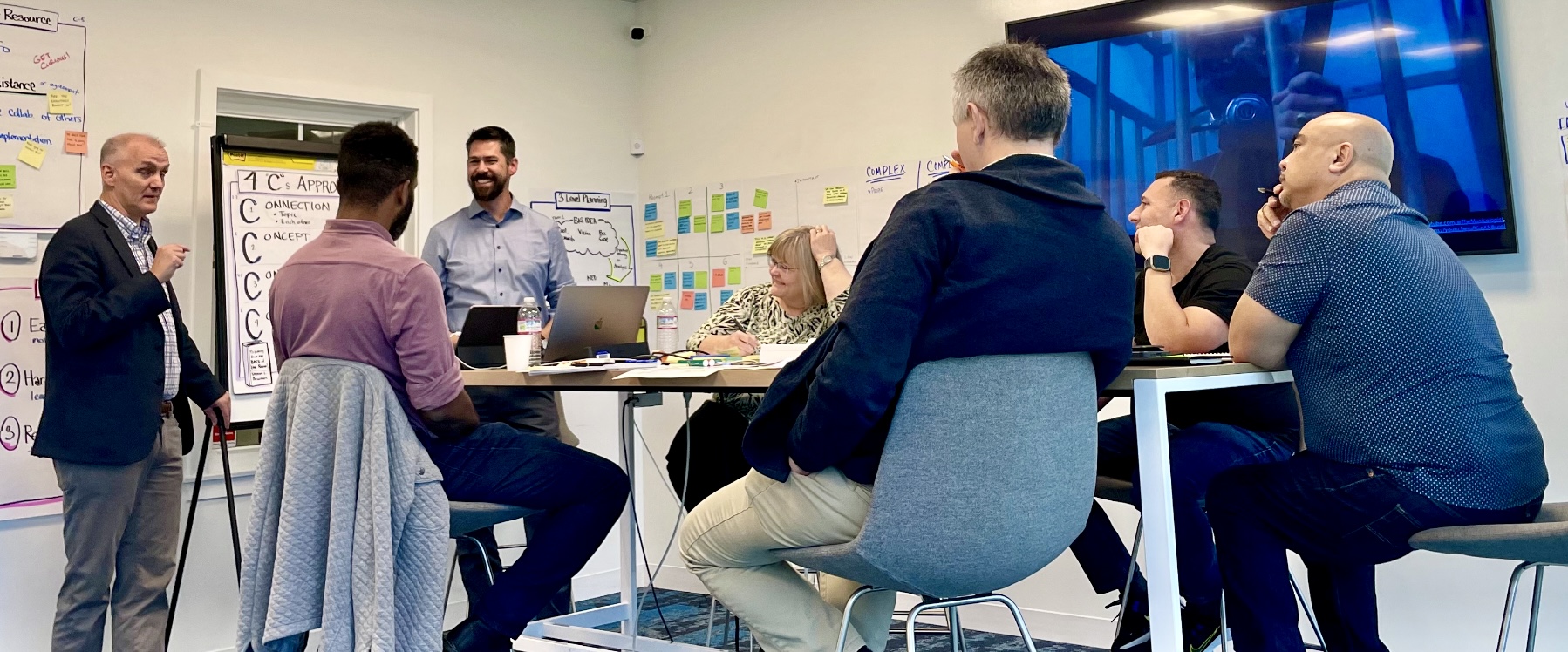
Earlier this month, we completed our first four-day Certified CAPED Consultant (CCC) workshop. It was a milestone we’d been anticipating (and writing about here) for a long time.
Five experienced practitioners joined us for the pilot. The first two and a half days were much like working with a new organization adopting CAPED. We moved through the CAPED Practitioner content, which included Strategic Planning, Active Planning, Analytical Planning, and Iterative Execution, using real scenarios and a fun, gamified simulation. Participants mapped complexity, created Reference Class Forecasts, and practiced tools like Feature Mining and risk-adjusted forecasting.
In other words, they didn’t just hear about CAPED. They practiced CAPED. Most of us know we should take a complexity-aware approach, but having the tools to do it systematically is empowering. We felt the excitement as our small cohort saw how they could use CAPED to fix long-standing issues in their organizations and make a big, positive difference for their businesses.
Then, in the final day and a half, we shifted focus. The first half of the week was about applying the framework; the second half was about preparing to teach it well. We shared the instructional design behind our facilitation. How we structure activities for discovery rather than lecture. How we focus on learning objectives, and how to make them stick. It was fun to watch awareness grow as we “pulled back the curtain” on creating engaging, transformational training.
With the teaching framework in place, each participant then did multiple drills teaching sections of the CAPED material—sometimes in small groups, sometimes to the full room—and received detailed feedback from peers and facilitators. The combination of practice and feedback made a visible difference. Confidence grew, language became sharper, and we could see the framework starting to become their own.
By the end of the four days, something special had happened. Yes, people understood CAPED more deeply. Yes, they left ready to bring it into their own organizations. But what stood out most was the shift in confidence and the sense that the group was in it together.
CAPED itself gives people a way to make sense of uncertainty. But teaching CAPED gave them a way to lead others through that uncertainty. One participant told us, “This is the starting point of a different way of thinking: solve complex things, solve complex things, solve complex things!” Another said, “We’re always afraid to go to the complex because it’s the unknown. CAPED gives us the guardrails and parameters on how to think about the problem we’re facing in a digestible way.”
There’s a lesson here that goes beyond CAPED:
In complex work, confidence doesn’t come from having the right answers from the start. It comes from having a trusted framework that helps you discover the right answers over time—and a community that helps you see what you might miss and supports you along the way. That’s why we built the CCC program around community and practice, not just certification. Complexity-aware planning isn’t something any one person masters in isolation. It’s learned together, through shared language, repeated application, and reflective feedback.
Looking Ahead
After this first CCC workshop, five new Certified CAPED Consultants are out in the world, ready to help their organizations plan and deliver more effectively in complex environments. Seeing them teach and make the material their own reminded us of why we do this work in the first place: to equip leaders and teams to handle complexity with clarity and wisdom, while staying connected to the human connection that makes the work meaningful in the first place.
We’re already looking forward to the next CCC workshop, where we’ll continue building this community of practitioners. If you’ve been experimenting with CAPED inside your organization and want to go deeper—to lead workshops, teach others, and connect with peers doing the same—join us for the next Certified CAPED Consultant training in Phoenix Feb 24-27, 2026.
But whether or not you ever pursue a certification, we hope the spirit of this work—learning through teaching, experimenting to learn, and planning with complexity in mind—informs how you approach your own projects this week.
Because in complex systems, the best way to build confidence isn’t to eliminate uncertainty. It’s to face it together, one experiment at a time.
Last updated