Most Product Owner conflicts aren’t really about prioritization. They’re about authority.
Who decides what belongs in the product vision? Who owns the roadmap? Who can say no when an executive shows up with an urgent request? And who owns what at different levels of hierarchy, for example, between a Director of Product and a Product Owner? These questions come up constantly in organizations using Scrum, and they’re rarely answered clearly.
The Scrum Guide gives us a few rules, but not much help applying them:
For Product Owners to succeed, the entire organization must respect their decisions … The Product Owner is one person, not a committee.
— Scrum Guide, 2026
That excerpt raises as many questions as it answers. Which decisions is the PO making? At what time horizon? And how are others are expected to be involved without turning the Product Owner into a committee?
Earlier this week, we published an article titled When and How to Use the 7 Levels of Delegation Well, which offers a practical way to make authority explicit instead of implied. In this week’s newsletter, we apply that thinking to one of the hardest Scrum questions to get right: Product Owner authority.
If you’ve ever felt that “the Product Owner owns the backlog” is true but not very useful, this example is for you. We’ll also point to the PO Board as a complementary pattern for making backlog conversations clearer and less political.
A Practical Example
We were recently working with an organization that wanted to do the right thing and fully empower their Product Owner. But the nuances got messy.
The Product Owner had experience with agile and had once been a developer, but they were working in a relatively new domain for them. The Director of Product was an industry expert in that domain and wanted to help the PO do the right thing, without making them feel micro managed. Other stakeholders, concerned that the ball was being dropped, were frequently stepping in with strongly worded advice.
We helped facilitate a conversation with the PO, the Director, and a few other key stakeholders. We introduced the PO Board as a way of splitting the backlog into Top, Middle, and Bottom sections. The Top represented the next two Sprints worth of ready to go, well refined stories. The Middle represented the next quarter’s roadmap of higher level features. The Bottom represented strategic options that were further than a quarter out from starting. (Learn more about the PO Board here.)
All participants read our article on the 7 Levels of Delegation in preparation for the session, and we started with a quick refresher on the key levels. We reminded participants that the goal was to empower the Product Owner as much as possible while still ensuring the best possible outcomes. We also acknowledged that, given the PO’s experience in this domain, that likely meant asking for advice at some levels of the backlog.
We then discussed the appropriate delegation level for each section of the PO Board and landed on the following, moving from right to left:
-
Top of the Backlog: PO owns at Level 6, Inquire
Middle of the Backlog: PO owns at Level 5, Advise
Bottom of the Backlog: Director owns at Level 3, Consult
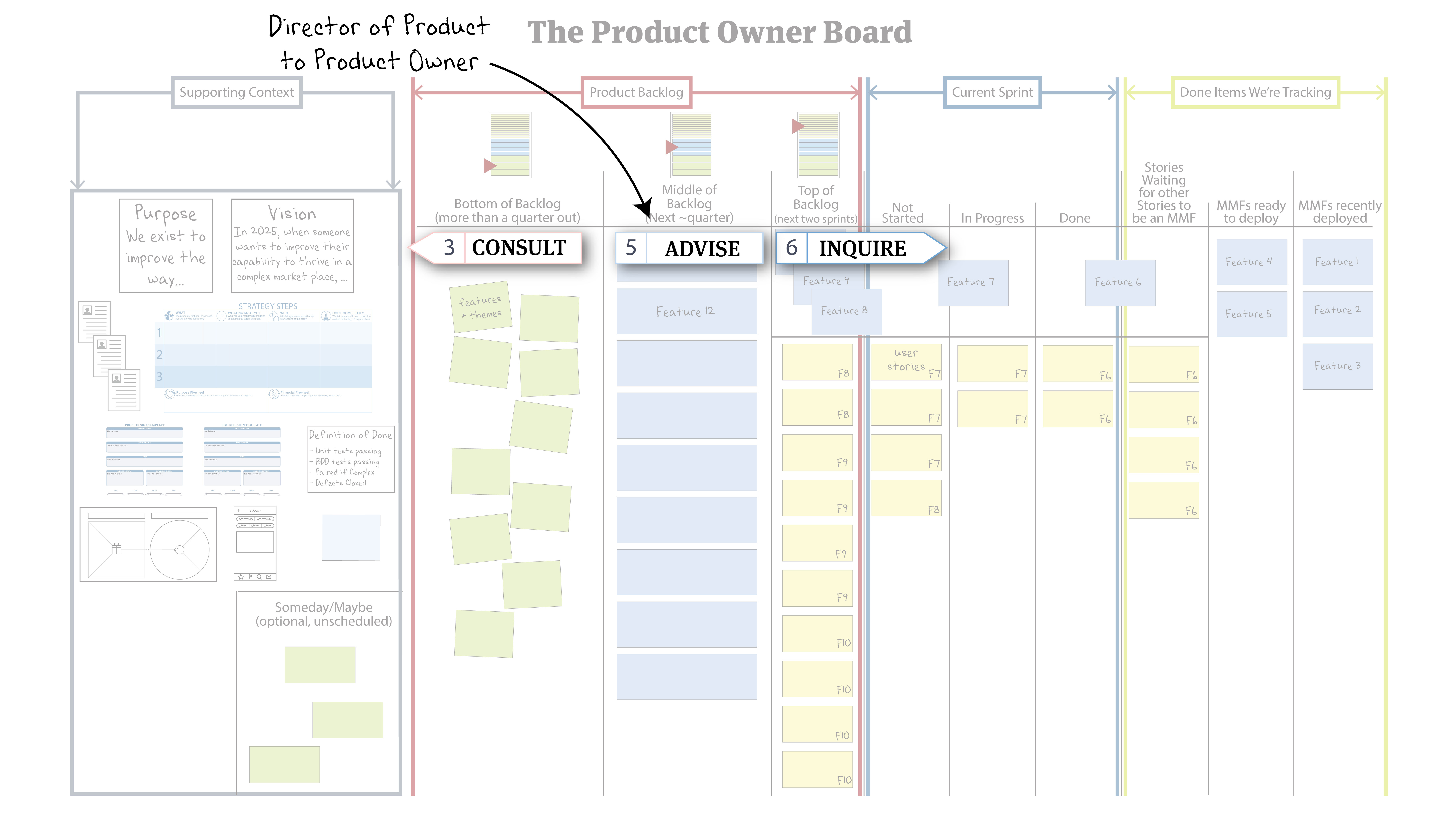
The Director also shared that they would like the PO to own strategy at a Level 5 in the future. But until the PO had a deeper understanding of the competition and customer, it made sense to keep that level with leadership, while explicitly consulting with the PO along the way.
If you run this exercise in your own organization, you may land on different agreements across the backlog. Two things mattered more than the specific choices this team made.
First, the agreements were explicit. Everyone could point to the same visuals and say, “This is how we decided authority works here.”
Second, the agreements were intentionally developmental. This PO was newer in the role. The leadership team was clear that the goal was not to freeze authority where it was, but to increase it over time. As capability and trust grew, delegation levels would move higher, and ownership would move further left on the PO Board.
The takeaway wasn’t a perfect model. It was a set of clear, shared agreements about authority that reduced conflict, sped up decisions, and gave the Product Owner a visible path to grow.
Go Deeper
Authority alone doesn’t create outcomes. Skilled Product Ownership does. Join us for an upcoming Certified CAPED Product Owner course and take your Product Ownership skills to the next level. Or, if the authority conversation is the one your organization needs to have, schedule a call to discuss how we can help.
Last updated