
We were working with a leadership team to clarify and apply their strategy, set expectations, and communicate it to the company when one of the leaders voiced her frustration.
“This is great, but when can we finish this and get back to the actual work?”
We asked what she considered the actual work to be.
“You know, running my department, getting the work done.”
Her comment captured a disagreement we see on many leadership teams. Some leaders see developing strategy and shaping expectations and communication as central to their job. Others see those activities as taking time away from the work they’re responsible for delivering. They can sit through the same meeting while holding very different ideas about what they’re there to accomplish.
And the disagreement matters. If we treat getting today’s work delivered as the whole leadership job, every hour spent clarifying direction, developing people, or improving how the organization operates has to compete with something that feels more urgent.
But consider what happens when those jobs go undone. People work toward conflicting priorities. Decisions wait for the boss. The same problems keep coming back. Leaders get pulled further into the details, leaving even less time to address the conditions that keep pulling them in.
The 3 Jobs of Management
We believe the actual work of leadership is creating the conditions for people to accomplish meaningful results together. A leader’s contribution should improve the work of many people, including work the leader will never personally touch.
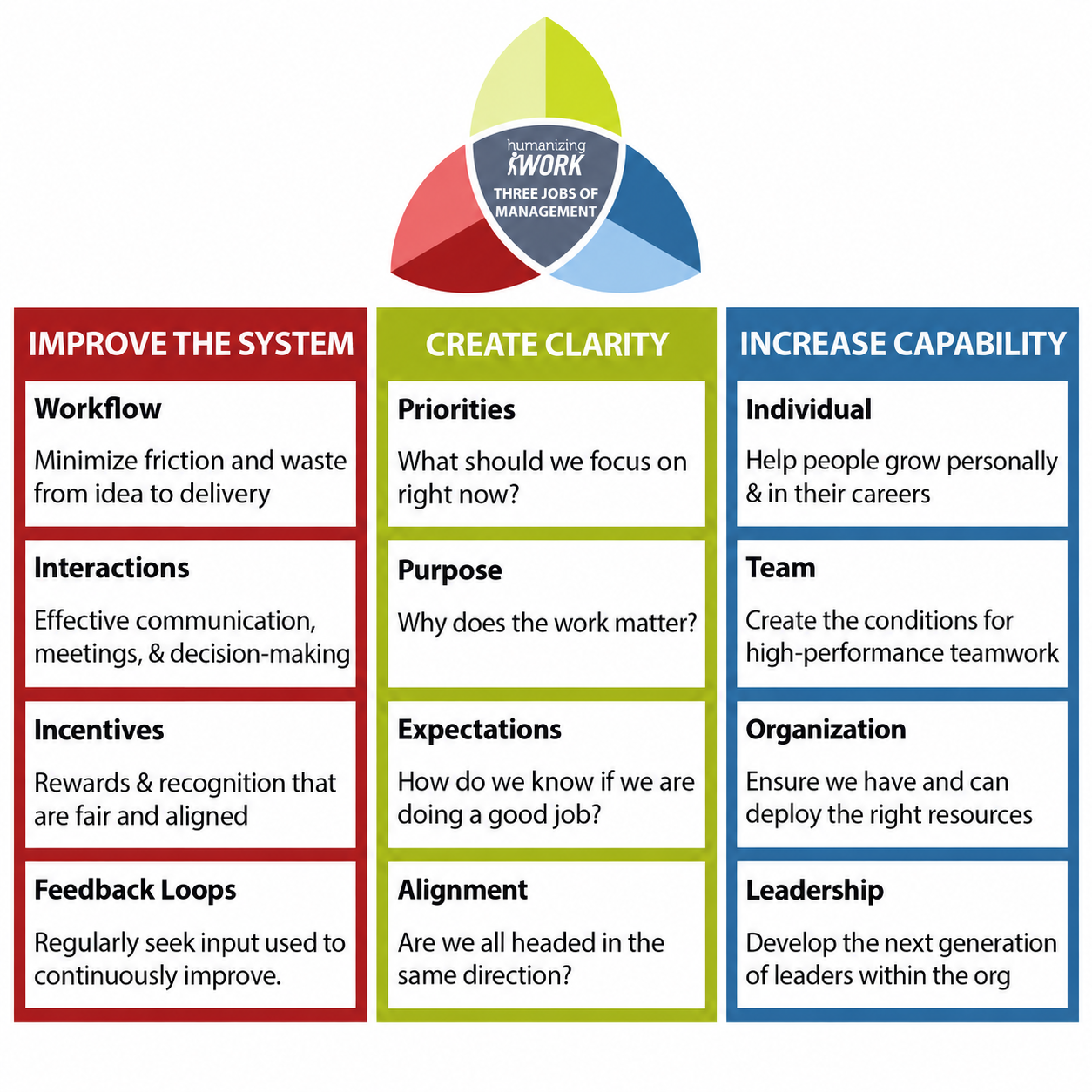
We use the 3 Jobs of Management to make that contribution concrete: Create Clarity, Increase Capability, and Improve the System.
Create Clarity
People need to understand what matters now, why it matters, what success looks like, and how their decisions fit with everyone else’s. Creating clarity includes making decisions and communicating them well enough that others can act.
Imagine two departments pursuing priorities that require the same people. Each department head can push harder and still make the overall situation worse. The leadership team needs to decide which outcome matters more, what will wait, and how to handle the tradeoff. That gives people in both departments a shared basis for deciding what to do next.
In uncertain work, clarity also includes what we don’t know yet, what we’re trying, and what we need to learn. It gives people enough shared direction to act and adjust.
Increase Capability
When the hardest work always comes back to the same leader, the organization’s capacity is constrained by that person’s time. Coaching someone through a difficult decision may take longer today than making it yourself. But when done well, it increases the number of people who can make that kind of decision in the future.
This job includes developing individuals and teams, securing the resources they need, and developing future leaders. The return shows up in the work people can handle well with less dependence on you.
Improve the System
Sometimes capable people with clear priorities still struggle because of how the work is organized. Work sits between departments. Meetings end without decisions. Incentives reward behavior that works against the stated strategy.
A leader can keep expediting individual pieces of work through those obstacles. Improving the workflow, decision process, or incentives addresses the recurring source of the problem. Each improvement can benefit many pieces of work, long after the leader’s immediate involvement ends.
Why this is the actual work
Together, these jobs improve the organization’s ability to deliver results repeatedly. Solving a problem personally solves it for now. Creating clarity, increasing capability, and improving the system help more people handle more problems well over time, with less need for individual leadership intervention.
They also explain why a leadership team needs to work together. Each leader sees part of the organization. The team can address conflicting priorities, capability gaps, and cross-department problems that no department head can resolve alone.
That brings us back to strategy, expectations, and communication. Strategy work creates clarity when it produces choices people can use. Setting expectations helps people understand what good work looks like. Communicating those choices and expectations across the company gives people a shared basis for action, including when they face a difficult decision and the boss isn’t in the room.
The frustrated leader’s question deserves a serious answer. A strategy meeting that produces vague aspirations, or a message to the company that leaves people unsure what to do, may well be wasting people’s time. Calling it leadership work doesn’t make it useful.
The test is what changes afterward. Can people make decisions they previously had to escalate? Can more people handle important work well? Does work flow with less friction? Are we learning sooner when something isn’t working?
Leaders will sometimes need to contribute directly. A deadline, an emergency, or a small team may require it. But notice when you repeatedly intervene personally, especially without trying to address the underlying need.
Put the 3 Jobs to work
If you’re on a leadership team, try discussing a problem that repeatedly lands on one of your desks. What needs to become clearer? What capability is missing? What in the system keeps producing the problem?
Then choose one change to test, agree on what improvement you expect to see, and come back to review what happened. That gives the team a way to connect its leadership work to the results everyone wants.
Download the pdf version of The Actual Work of Leadership
Last updated