Timing can matter more than ROI
Two big features (or small initiatives) are competing for top priority. One is projected to bring in about $500k of new annual revenue by picking… Read More
Two big features (or small initiatives) are competing for top priority. One is projected to bring in about $500k of new annual revenue by picking… Read More
In recent conversations with two different clients, they lamented backlogs full of AI slop. Piles of detailed epics and stories no one really chose or… Read More
Our clients treat org and process changes as complex problems to solve with experiments, or probes. But unlike, say, chemistry or physics experiments, the measurement… Read More
The steering committee for a big core-system program meets once a month. The program manager walks through the status deck: milestones completed, budget on track,… Read More
“I wish I had that delegation model 50 years ago when I founded this company–things might have gone a lot better!” -End of day quote… Read More
This summer, we led CAPED Agile for Teams training for more than 100 people at one of our clients. On the final day, one of… Read More
A product owner I’m coaching recently pushed through the hard part of a backlog overhaul. They organized a sprawling pile of stories into features, put… Read More
“This is our top priority now. Everything else falls by the wayside.” A leader at one of our clients said this recently to a product… Read More
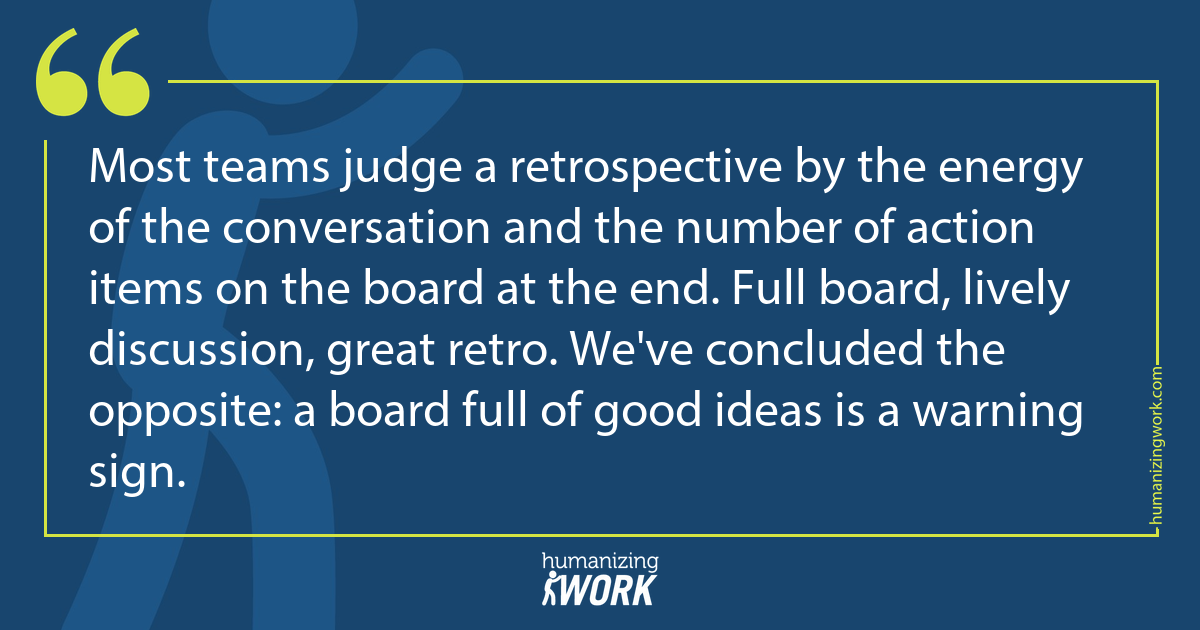
Most teams judge a retrospective by the energy of the conversation and the number of action items on the board at the end. Full board,… Read More
In our coaching, we often hear, “Our sprint length is too short. We want to change it from X to Y weeks.” The time box… Read More